Cross Cultural
Como
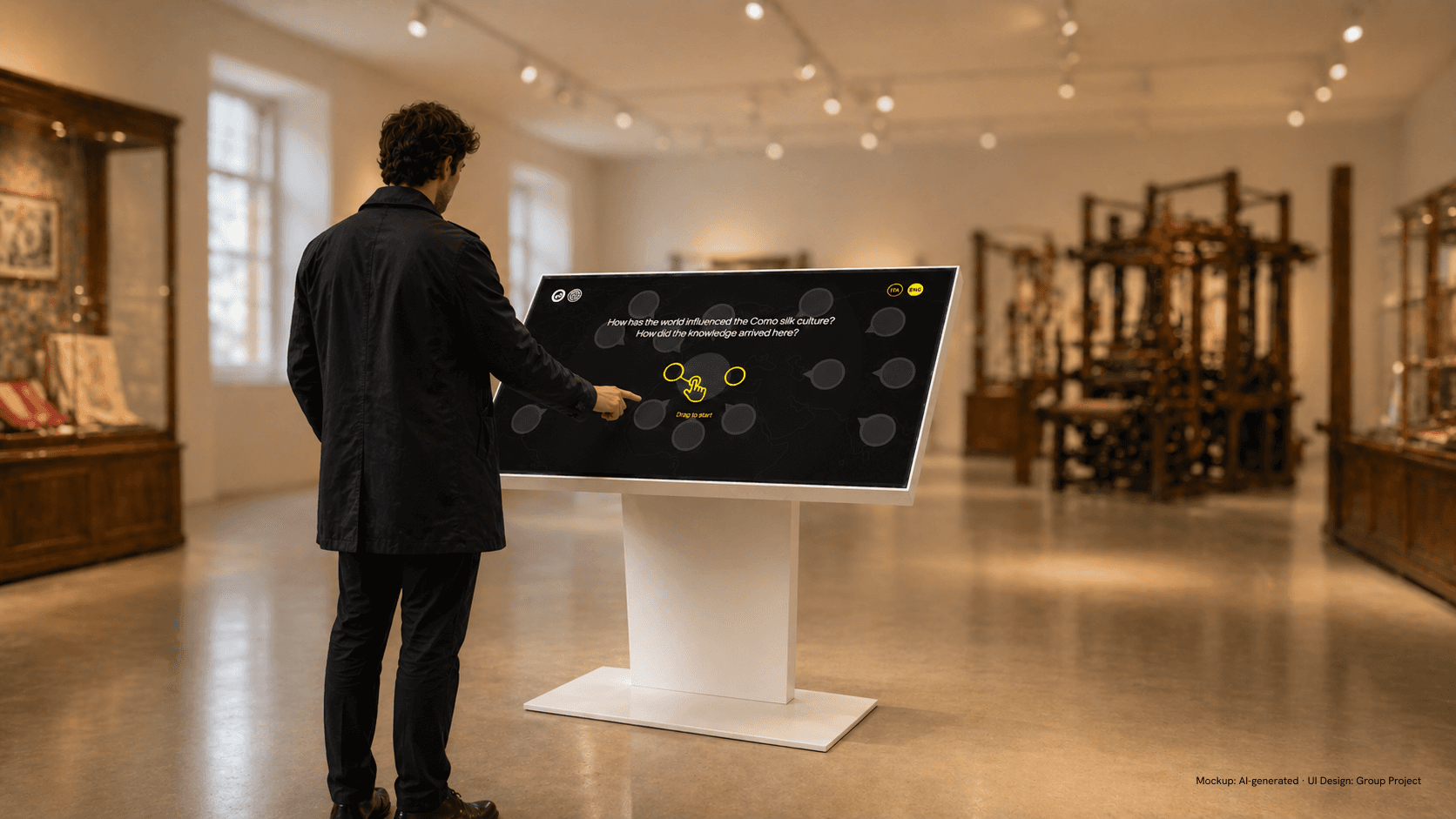
A dual-surface digital experience that uncovers the global origins of Como's silk heritage: connecting museum objects to the countries, trade routes, and techniques that shaped them.
ROLE
Service Design, Group Project
Type
Mobile App, Horizontal Screen
CONTEXT
Politecnico di Milano (2024)
TOOLS
Figma, ML scan
PROBLEM 01/05
SOLO VISITOR GAP
Independent visits require a guide to make sense of the heritage: the museum depends on human mediation.
NO CULTURAL CONTEXT
Objects are displayed without their international origins: the Moroccan draw-loom, Jacquard, Chinese silk trade are invisible.
DISCONNECTED GLOBAL STORY
Dieser Text ist bereits korrekt. Es gibt keine Gedankenstrich mehr und die Rechtschreibung ist fehlerfrei.
STATIC INFORMATION LAYER
A4 sheets and instrument tags cannot convey the depth of 600 years of cross-cultural silk exchange.
INSIGHT 01
SOLO VISITORS
Solo visitors struggle to understand the heritage compared to guided visits, because right now it requires interaction with people who know about it.
INSIGHT 02
CULTURAL GAP
There is a gap in connecting the museum with different cultures and providing a historical context for the displayed objects: the global significance is invisible.
Research 02/07
We inventoried the museum as a system across three concentric rings: inside the museum, around it, and outside it. Every actor, touchpoint, room and heritage layer was catalogued and connected, from instrument tags and audio guides to economical supporters and city signage. The two insights above are not assumptions; they fall out of this map.


Three rings, one method
The same touchpoint framework was applied inside, around and outside the museum, so gaps show up as empty space rather than opinion.
Where the gap sits
Digital experiences cluster around marketing and social media. Inside the rooms, the information layer is almost entirely analog and mediated by people.
What it decided
The map located the intervention: a digital layer that lives with the heritage itself, not another channel around the museum.
Audience 03/07
The target group was narrowed in three deliberate steps. This funnel is the reason the solution has two surfaces; the architecture follows the audience, not a preference for more screens.

DESIGN APPROACH 02/05
Instead of a single interface, Cross Cultural Como was designed as two distinct surfaces serving two distinct physical contexts: a visitor with a phone in front of a loom, and a curious walk-in at the museum entrance. Both share one content layer: the cross-cultural history of Como's silk objects.
01
Personal SMARTPHONE
IN THE MUSEUM
Heritage App
KEY FUNCTIONS
Visual museum map: navigate by room
Heritage stories collection, unlocked by scanning objects
ML object recognition + QR code fallback
Visual museum map: navigate by room
02
HORIZONTAL SCREEN
MUSEUM ENTRANCE
World Map Installation
KEY FUNCTIONS
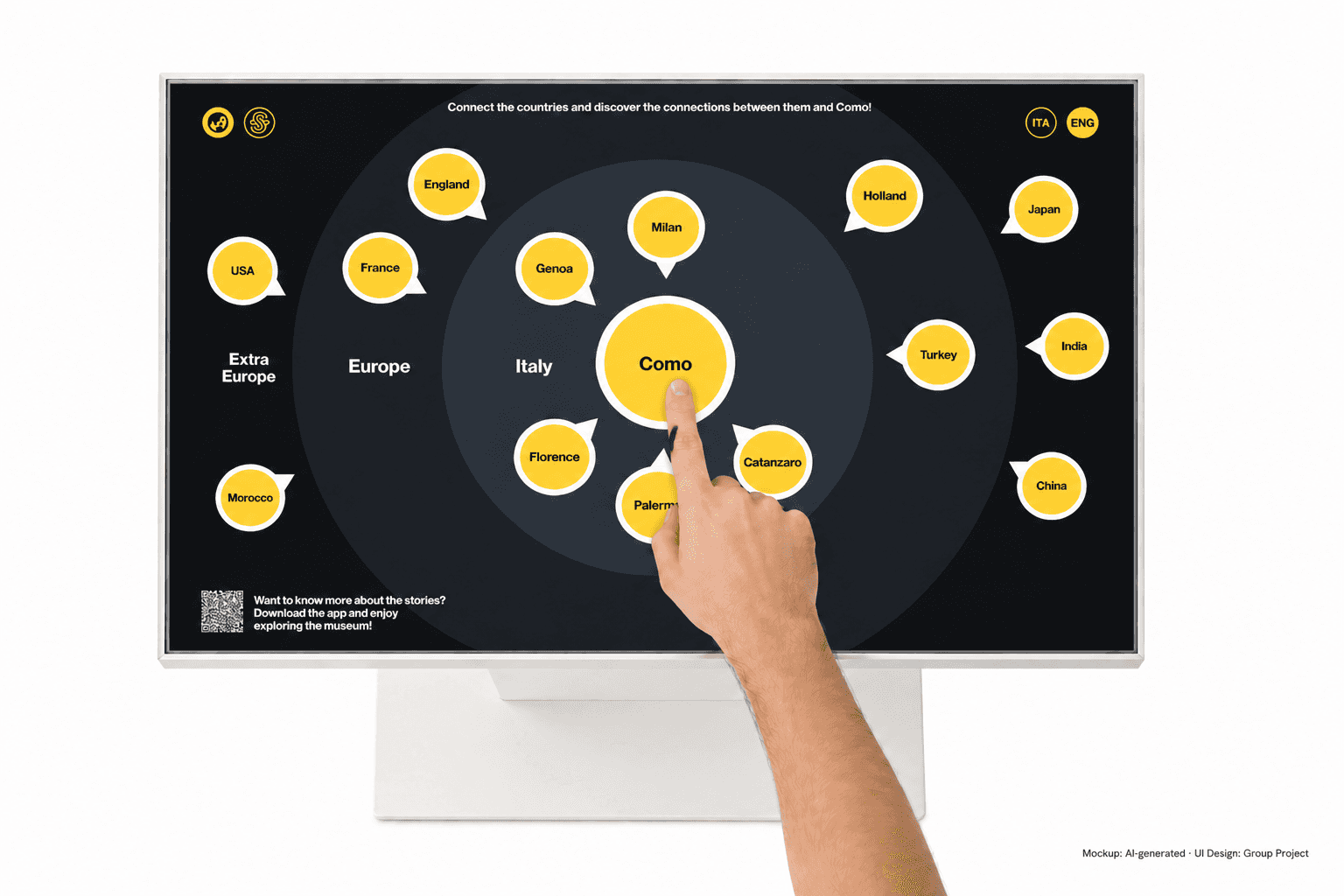
Interactive world map: connect countries to Como
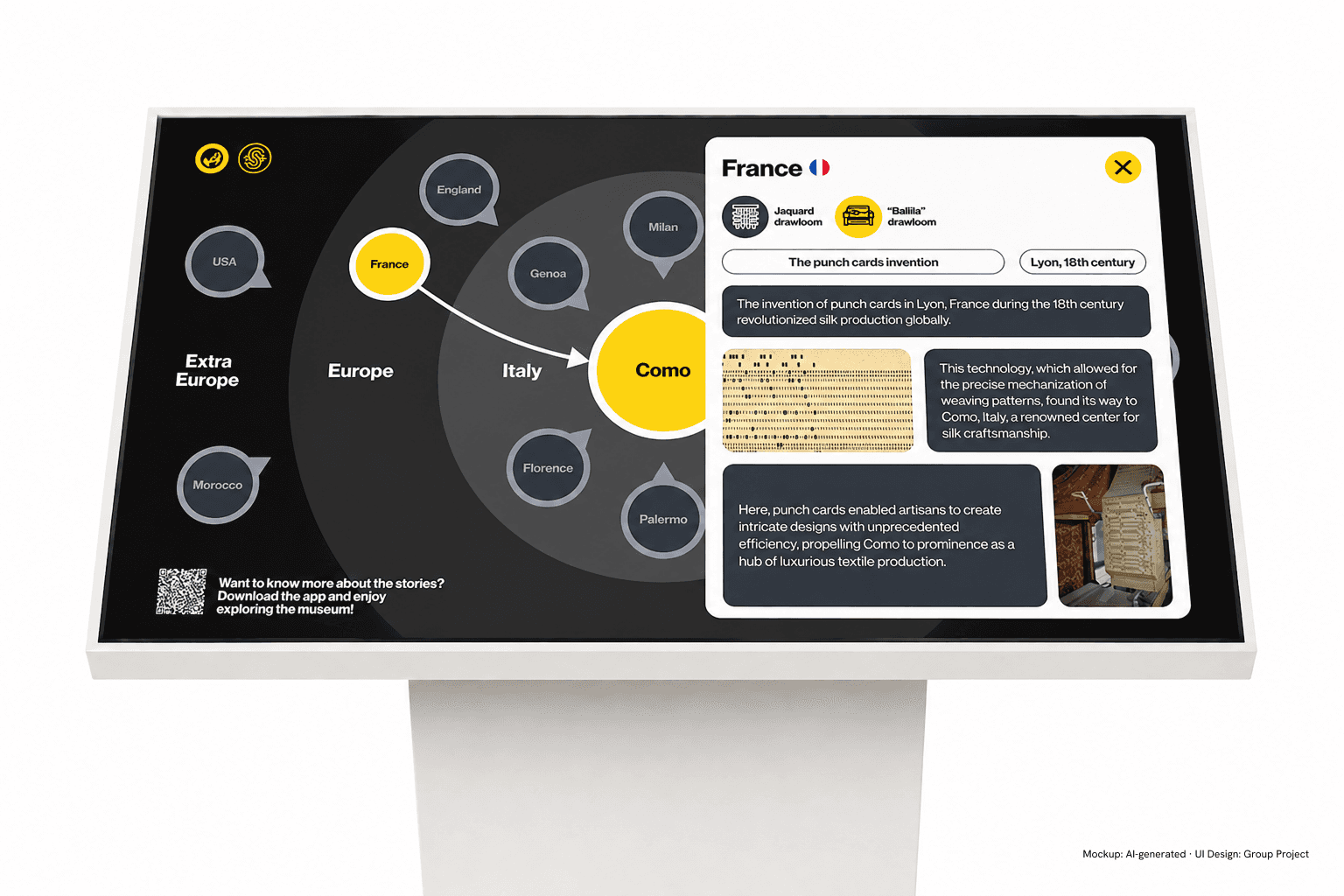
Cultural influences surfaced through heritage history
Spun: country-level silk storytelling, no download needed
QR code to download the app for the full experience
DESIGN 03/05
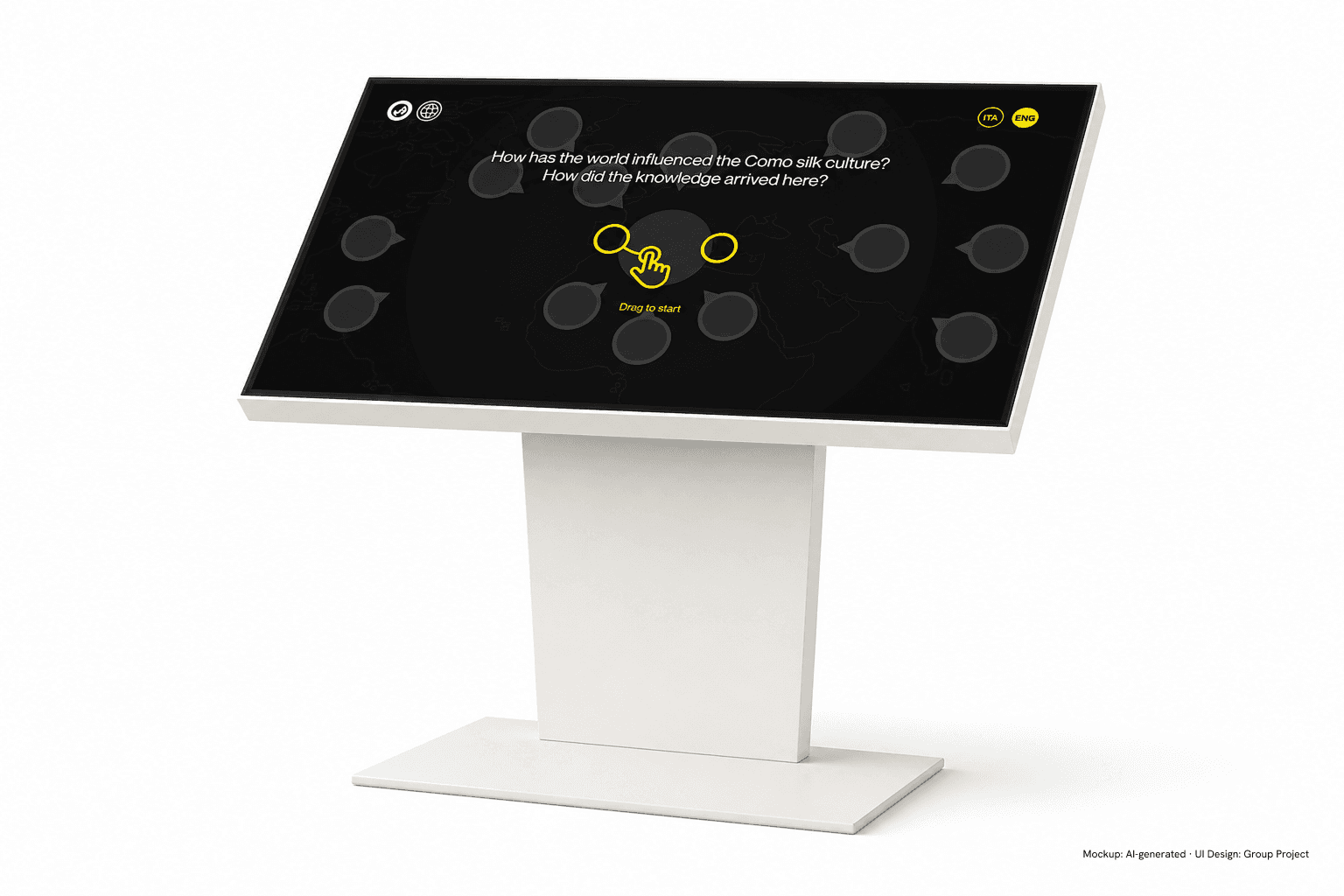
The horizontal touchscreen at the museum entrance runs without the app. It lets any visitor (with no phone, no download) immediately grasp that Como's silk is a global story, not just a local one.
Radial map, Como at centre
Positions the museum as the global nexus of silk history, not a provincial exhibit.
Concentric rings:
Italy → Europe → World
Mirrors the positioning diagram from the research phase.
Tap a country to open its silk story
The interaction requires zero instruction; curiosity drives the whole flow.
Two-option home
Binary choice removes all cognitive load for a visitor who has just walked in; no menus, no orientation needed.
ITA / ENG toggle
Foreign tourists are a core audience; language selection is surface-level, not buried in settings.
QR to app persistent
Every screen on the horizontal display shows the app download CTA; the installation converts walk-ins into app users.
WHY SPUN AS A NAMED FEATURE
Giving the AI storyteller a name and identity transforms it from a search tool into a guide. Visitors engage more readily with a named, characterised voice, especially in a cultural institution context where trust matters.
THE CONSTRAINT
The horizontal screen is a shared public installation. Spun's content had to work without personal accounts or saved sessions, every interaction starts fresh, which shaped the stateless conversational model.
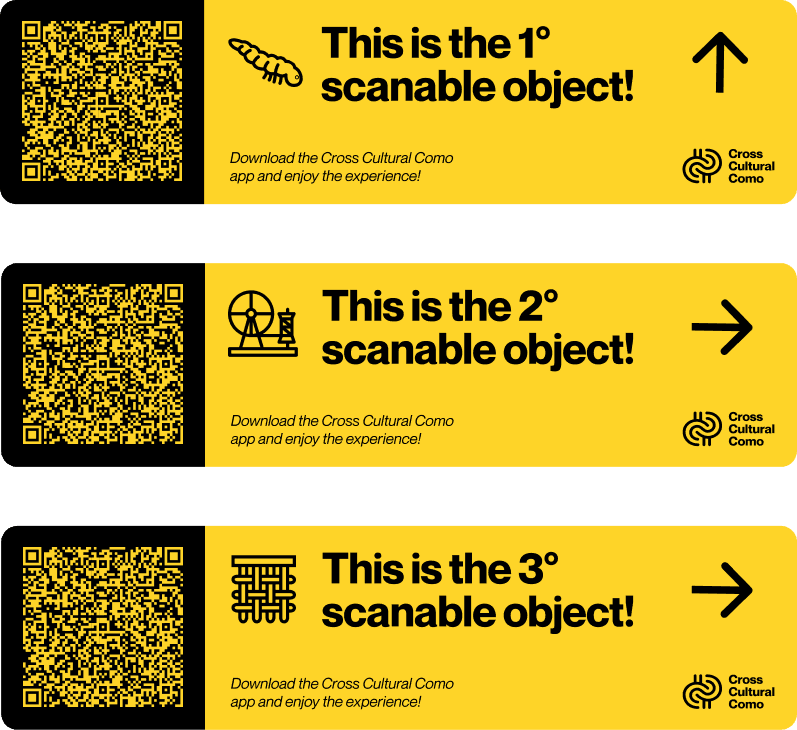
The service does
not stop at the screen.
Onboarding in the room
The first label doubles as the app's acquisition point: scanning it prompts the download for visitors who arrived without it.
Wayfinding built in
Directional arrows sequence the scannable objects, so the discovery arc follows the physical route through the rooms.
Reliability by design
Labels are the guaranteed path when ML recognition fails; the experience degrades gracefully instead of breaking.

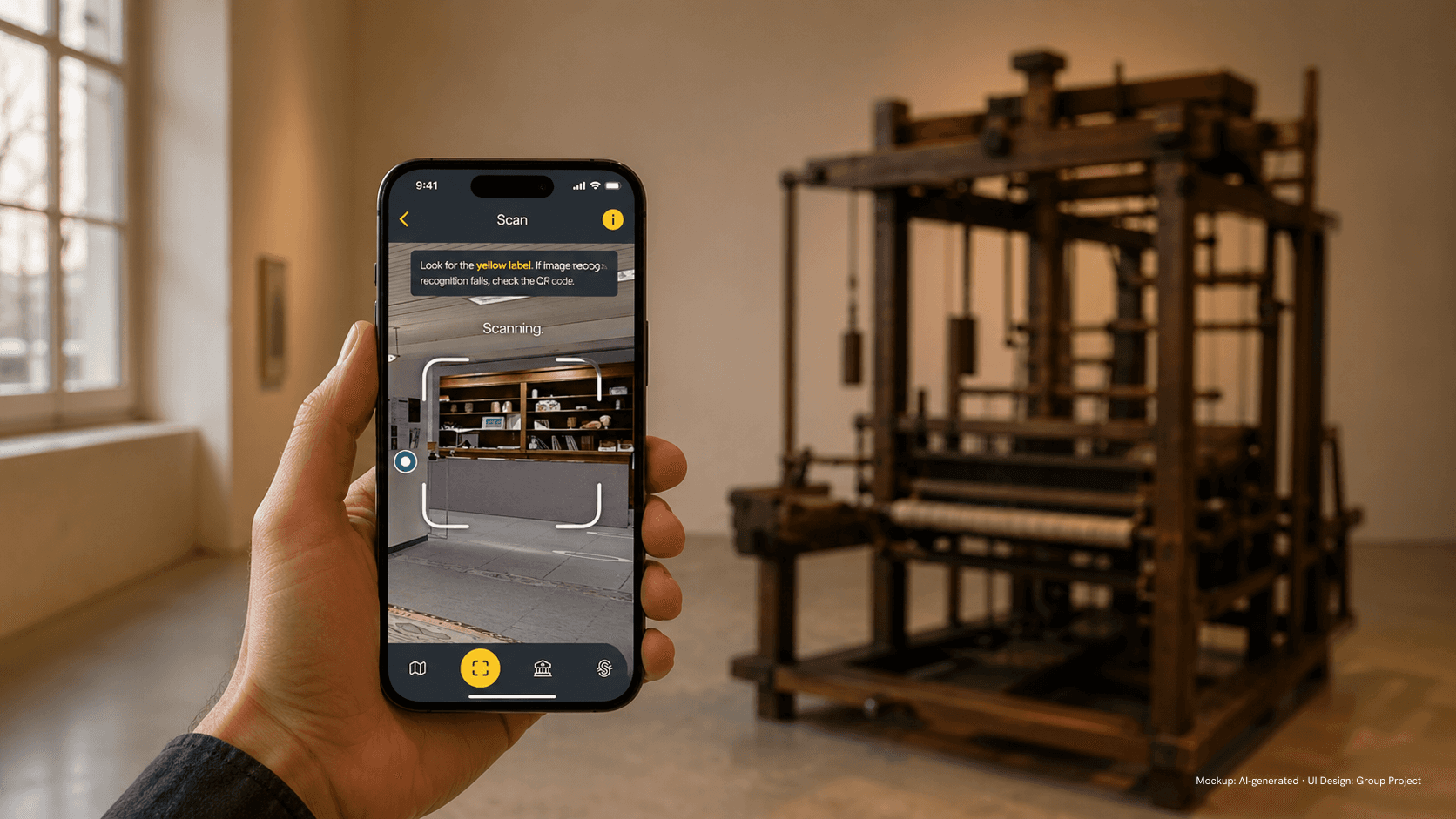
The app is built around a single interaction: scan a machine, unlock its story. Every screen answers one question: where did this object come from, and why does it matter to the world beyond Como?

Lock metaphor for
locked stories
Creates a sense of discovery without suggesting the visitor is excluded.
Room-based navigation mirrors physical layout
Visitors can orient themselves without cognitive overhead.
Object recognition via a pre-trained ML model is the ideal interaction
Frictionless, no signage required. The QR label is the reliable fallback for low-light rooms, glass cases, and non-standard machine angles.

White card on dark bg
The story "surfaces" from the dark room, reinforcing the moment of discovery.
Collection tab separate from map
Visitors who want a list view can switch; map-first respects the physical context.
Spun as persistent bottom CTA
Not buried in menus; researchers can always access deeper AI-powered content.

Spun as persistent bottom CTA
Not buried in menus; researchers can always access deeper AI-powered content.
THE ALTERNATIVE REJECTED
NFC tags: rejected due to museum infrastructure constraints and the physical positioning of machines, which made reliable tap-placement impractical for all visitor heights.
Visual foundations 04/05

Neue Montreal.
8-point grid.
3 core tokens.
Neue Montreal was chosen for its confident, curatorial personality: the right balance between editorial precision and approachability for a museum audience. The 3-colour system (yellow, black, white) is strict: yellow is reserved exclusively for interactive elements and active states, keeping affordances unambiguous even on a noisy museum floor. An 8-point grid ties both screen formats together (portrait mobile and landscape 4:3 entrance screen), ensuring spatial consistency across two very different physical contexts.
Reflection 05/05
WHAT WORKED
The dual-surface architecture solved two completely different contexts without fragmenting the content: a solo phone-user inside the museum and a group of walk-ins at the entrance both access the same cultural layer. The lock/unlock metaphor created a discovery arc without requiring any onboarding. The strict 3-colour system kept the dark UI legible and the yellow affordances unambiguous in unpredictable museum lighting. Positioning Como as the nexus on the world map, rather than a destination on it, reframed the entire museum narrative.
WHAT I WOULD DO DIFFERENTLY
Run field observation sessions with solo visitors before finalising the scanning flow: the ML recognition model was designed top-down, and real-world museum lighting, glass cases, and visitor posture would have revealed edge cases earlier. I would also test Spun's content depth against visitor attention spans in situ: the AI storytelling feature is the project's most ambitious element and the one most at risk of being too long for a museum-floor context. A museum staff co-design session was missing; the content layer was reconstructed from labels and existing documentation rather than curators.