Pop Your
Bubble
A news app that lets you read the world through someone else's filter bubble. Designed as my Vordiplom in 2022, audited and rebuilt to my professional standard in 2026.
ROLE
Solo Designer: concept, research, UI, content
Type
Vordiplom/Pre-Diploma
Self-initiated redesign (2026)
CONTEXT
10 weeks (2022)
02 weeks (2026)
TOOLS
Figma, InDesign (2022) · Figma, HTML/CSS (2026)

PROBLEM 01/09
The project builds on Eli Pariser's filter bubble argument: algorithmic personalisation pre-sorts the world into what we already agree with. The convenience is real, and so is the cost. Democracy requires knowing that other standpoints exist; a feed optimised for confirmation quietly removes them. Four systemic problems framed the 2022 concept:
INVISIBLE CURATION
What is removed from a feed is never surfaced: users cannot know what they are not seeing.
LOCKED PROFILES
Algorithmic identities accumulate silently and are impossible for the user to inspect or reset.
ECHO CHAMBER
Content that confirms us is pleasant to consume; content that challenges us is friction. Engagement optimises for the former.
NEGATIVITY DEFAULT
Mainstream feeds optimise for engagement; positive and constructive stories are systematically deprioritised.
DESIGN APPROACH 02/09
You cannot design a space without filters, so Pop Your Bubble makes the filter visible and lets you swap it. Your View is black: fixed, generated from your behaviour, not yours to edit. Other View is white: a projection surface you can shape, borrow from a friend, or build from scratch. The colour logic deliberately reverses Western symbolism, because the point is that neither perspective is the neutral one.
A three-second image game trains the algorithm through instinct instead of forms, and five personality dimensions, drawn from the Big Five model, render each bubble as a simple, readable graphic. This mechanic survived every iteration between 2022 and 2026 untouched.
01
BLACK UI
YOUR VIEW
KEY FUNCTIONS
Generated from behavioural data
(read-only)
Personality profile shown via Five-Factor Model
Updates automatically as reading patterns shift
02
WHITE UI
OTHER VIEW
KEY FUNCTIONS
Up to 8 manually configured personality profiles
Or connect directly to a friend's real profile
Renders the same feed through a different filter
03
DISCOVERY
EXPLORE & HAPPY PAGE
KEY FUNCTIONS
Explore: articles outside your current interest profile
Percentage indicator shows distance from your bubble per article
Happy Page: positive global news, interest-balanced
THE 2022 ORIGINAL 03/09
Registration skips topic checkboxes entirely. Instead users choose between image pairs in under 3 seconds: time pressure forces intuitive choices the algorithm can use reliably. Hesitation is registered as a signal too. The output is a personality profile across five dimensions, not a list of interests.
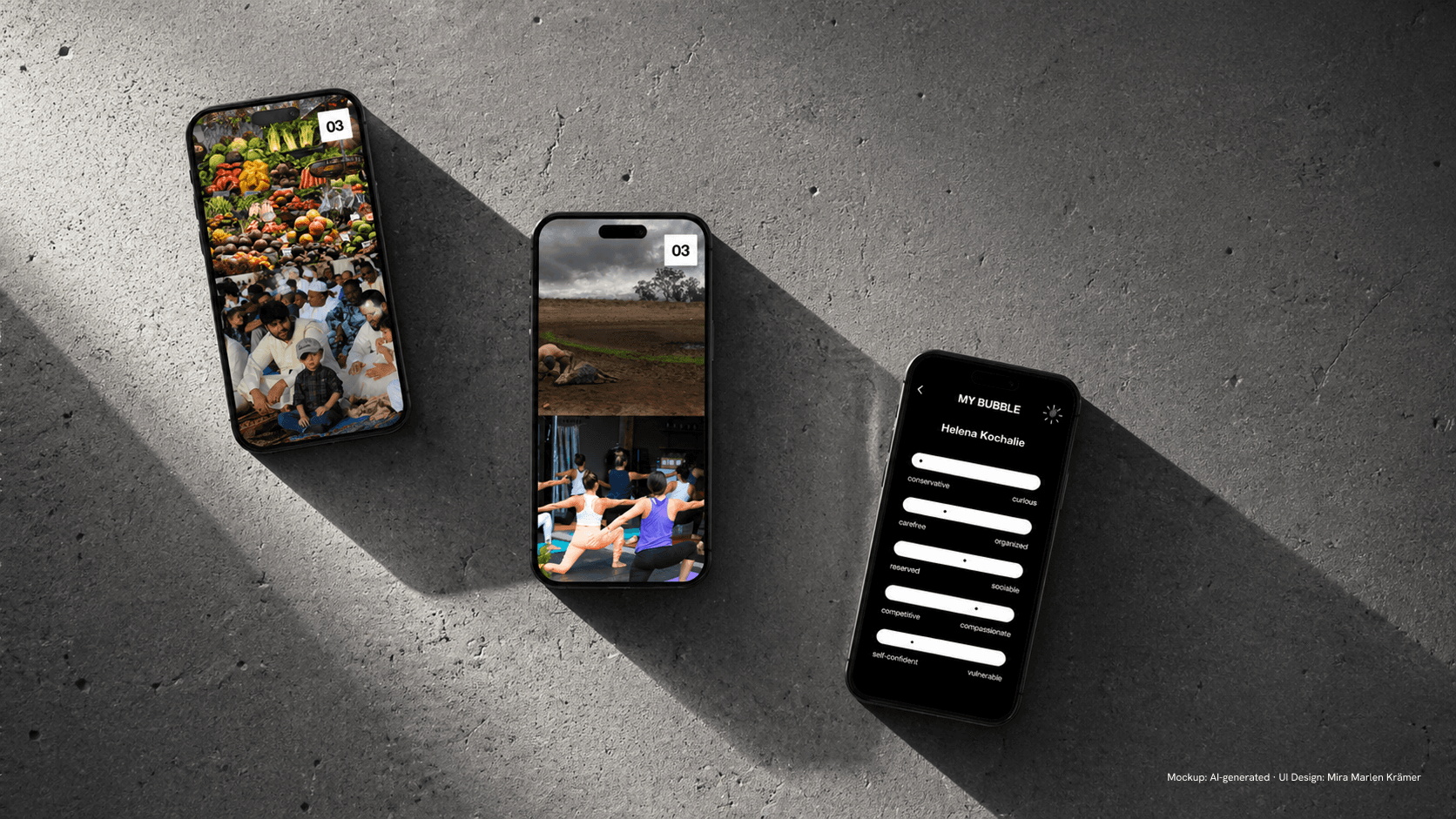
Image pairs,
not topic checkboxes
Forces intuitive choices; users cannot construct a flattering false profile.
3-second time limit
Decision delay is itself a signal; hesitation reveals genuine interests the algorithm can weight.
Five-Factor Personality Model output
Maps to established psychological dimensions so the profile display is legible, not arbitrary.
Every section carries the YOUR VIEW / OTHER VIEW toggle. Global and Local follow standard news categories. Sublocal surfaces stories within a 60 km radius and pairs them with an equivalent event elsewhere in the world. The Happy Page is positive news only, balanced across interest areas regardless of the user's profile.
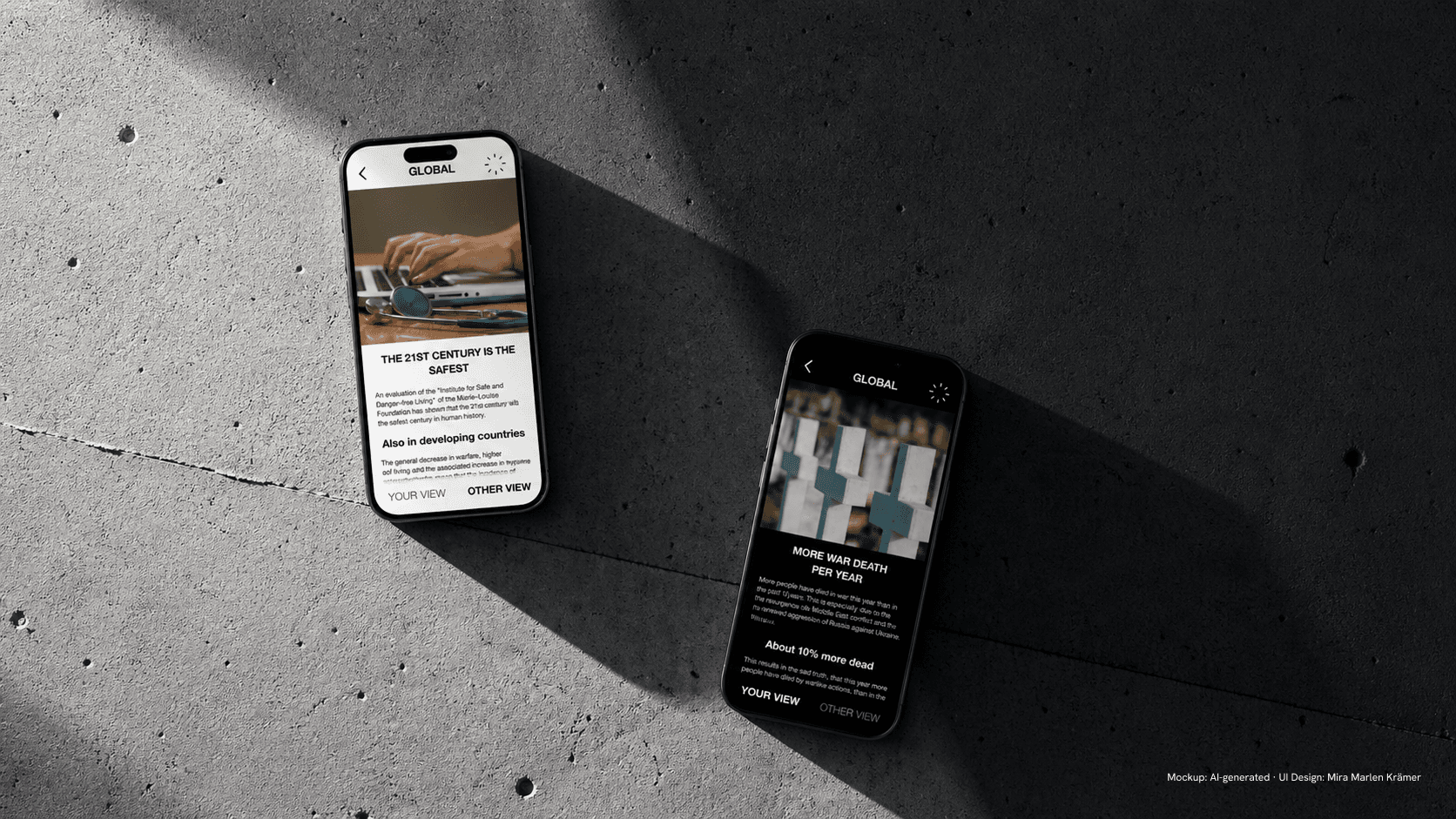
Black for YOUR VIEW,
white for OTHER VIEW
Neither framed as neutral; the colour inversion is the conceptual argument, not decoration.
Same topic,
different editorial framing
Both articles address the same subject; only the perspective and emphasis shifts, not the subject matter.
Category tabs persist
across both views
Politic, Economics, Opinion remain consistent; only the algorithmic filter changes, not the navigation taxonomy.
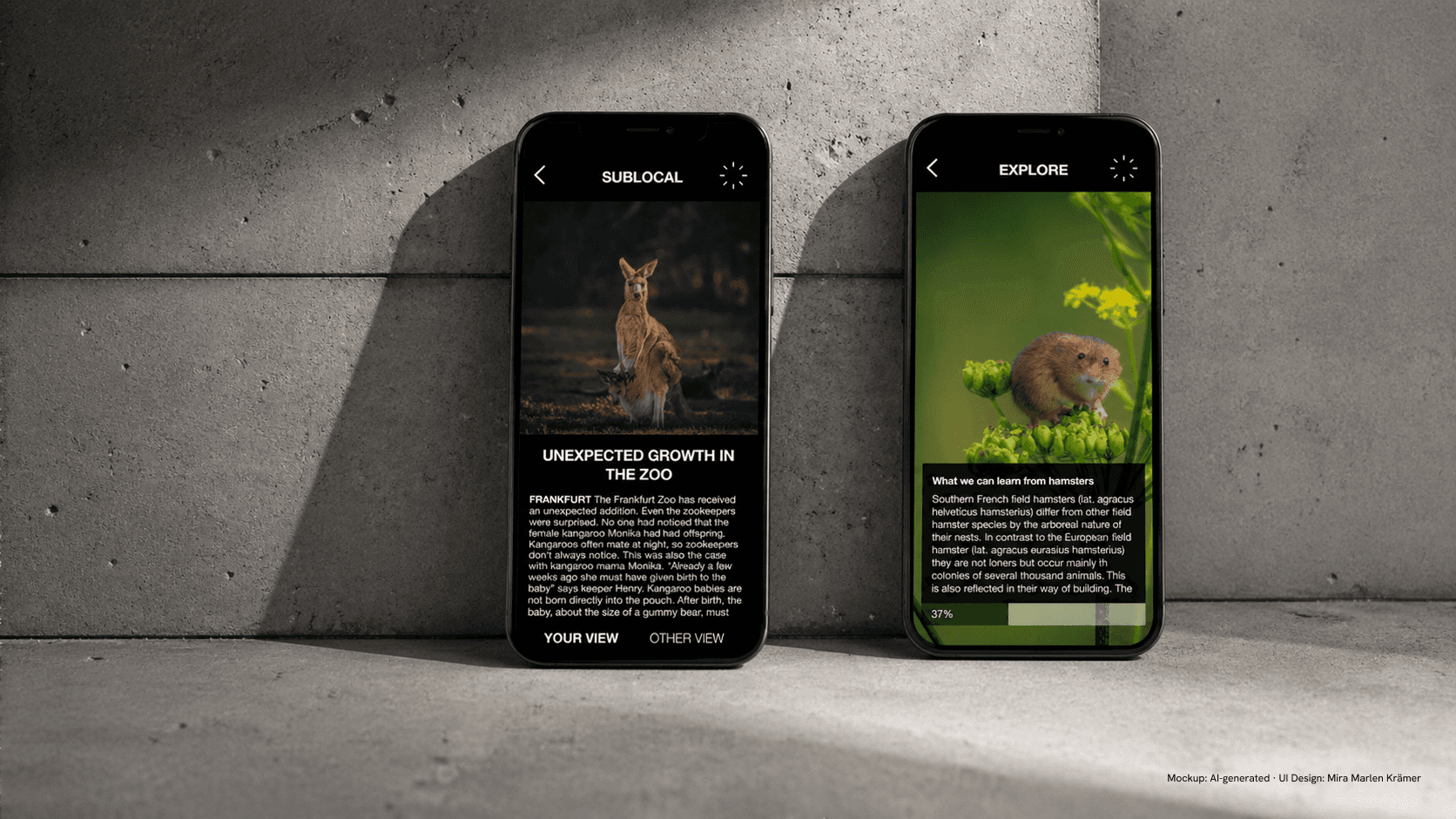
WHY SUBLOCAL WORKS THIS WAY
YOUR VIEW shows stories within 60 km: local relevance is preserved. The OTHER VIEW mirrors the same event type elsewhere in the world. Users see that their situation has a parallel somewhere else, without losing the local anchor.
THE ALTERNATIVE REJECTED
Showing an unrelated global story in the Other View. Rejected because it loses the structural parallel: matching event type to event type is more legible and more meaningful than simply swapping geographic scope.
THE 2026 AUDIT 04/09
After three design roles at Mercedes-Benz, I reopened the project and audited it against WCAG 2.2, the Apple Human Interface Guidelines and Material Design. The concept held. The craft did not. Seven of 23 findings drove the redesign priorities:
FINDING
PROBLEM IN 2022
.
STANDARD
Timing
The game's 3-second limit could not be extended, paused or disabled.
WCAG 2.2.1, Level A failure
Contrast
White text sat directly on photographs without a reliable scrim; hairline outlines on black missed the 3:1 minimum.
WCAG 1.4.3 / 1.4.11
Colour as signal
The black/white theme flip was the only cue that the perspective had changed.
WCAG 1.4.1
Touch targets
List rows, back chevrons and add-buttons sat well below 44pt.
Apple HIG / WCAG 2.5.8
Navigation
Five sibling sections reachable only through back-chevron chains; no persistent navigation.
HIG navigation patterns
Typography
One typeface, two sizes, everything important centred and in caps.
Craft, not compliance
Language
Loaded trait labels ("conservative", "vulnerable") judged users instead of describing behaviour; spelling errors reached final artwork.
Content design
DESIGN QUESTION 05/09
This question shaped both versions, but the 2026 pass took it further than pixels: if the Other View reads as a correction, the product's thesis collapses into "your view is wrong", which was never the argument.
Interface, motion and editorial voice all had to answer the same question the same way.
REDESIGN 06/09


Visual foundations 07/09

Archivo & Inter.
4pt grid.
Reflection 08/09
WHAT WORKED
The 2022 concept survived a 2026 audit intact: the semantic colour inversion, the instinct-based game and the honest "you can't edit your own bubble" stance are decisions I would still defend in any critique. Auditing my own work against WCAG 2.2 and platform guidelines produced better design than taste alone; the adjustable timer and the labelled theme flip made the concept stronger, not just compliant. And half of the improvement was language, not pixels: trait labels that describe instead of judge, articles that coexist instead of debunk.
WHAT I WOULD DO DIFFERENTLY
I would test the semantic theming against OS dark-mode expectations with real users; it deliberately fights a platform convention, and that tradeoff deserves evidence, not just an argument. The one-story-per-screen reader trades scanability for focus and needs a feed level above it. And I would run the three-second game with participants across age groups before defending the default timing. These are open questions I would take into usability testing.
resources 09/09
Notes:
All articles, institutes and personal data shown in the app are fictional placeholders and make no claim to accuracy, in the 2022 original as in the 2026 redesign. The 2022 screens on this page are unretouched artwork from the printed Vordiplom booklet. The 2026 screens shown in section 06 are based on the project's design tokens.
TWO VERSIONS, ONE PROJECT
The concept, research and original design are my 2022 Vordiplom at HfG Offenbach, supervised by Prof. Janina Anjuli Schmidt.
The 2026 interface redesign is self-initiated and was not part of the graded work.
GROUNDED IN Research
Pariser, E., 2011. The Filter Bubble: What the Internet Is Hiding from You. New York: Penguin Press.
Rosling, H., Rosling, O. & Rosling Rönnlund, A., 2018. Factfulness. London: Sceptre.
W3C, 2023. Web Content Accessibility Guidelines (WCAG) 2.2. W3C Recommendation.